Why Evalio

Evalio exists because Total Rewards decisions deserve defensible decision infrastructure.

Not another dashboard. Not a static consulting deliverable. Not an HR system that stores data without governing the decision. A controlled path from evidence to decision confidence, governed end-to-end.

Founding beliefs

What we observed in the market — and what we built in response.

Five observations that shape how Evalio operates today.

  1. Total Rewards decisions are too often made on fragmented evidence.

    Spreadsheets, survey extracts, vendor reports, and tribal knowledge live in different places. The decision-maker stitches them together at the last possible moment — and the rationale is rarely captured.

  2. Leaders need defensible decision infrastructure, not another dashboard.

    A CHRO, a CFO, or a CEO does not need more raw data. They need a controlled path from evidence, to scenario, to consultant review, to a recorded decision they can stand behind.

  3. Traditional consulting outputs are often static, opaque, and hard to operationalize.

    A long deliverable rarely survives the next budget cycle. Methodology stays with the consultant. The client inherits a snapshot, not a governed system.

  4. HR systems store data — they do not govern reward decisions end-to-end.

    HRIS, compensation tooling, and survey portals each own a slice. The connective tissue — the workflow from role evidence through Decision Room — is missing.

  5. Evalio gives leaders a controlled path from evidence to decision confidence.

    One operating layer that holds the evidence, runs the governed workflow, surfaces representative previews before purchase, applies advisory AI without removing human judgment, and records the decision with its rationale.

Fragmented decision stack

The problem is not lack of data. It is lack of a governed decision path.

This section consolidates the strongest safe idea from the Vite source: Total Rewards decisions become hard to defend when evidence, scenarios, review, and approvals live in separate places. Evalio brings the work into a structured proof and decision corridor.

Role evidence

Role context, scope, accountabilities, and evidence often sit across documents, emails, and stakeholder memory.

Market reads

Survey extracts and market signals frequently live outside the decision workflow, making change hard to explain later.

Internal equity

Equity risks are often discovered late, debated informally, and separated from the final approval trail.

Cost impact

Finance needs a defensible cost view, not a disconnected number without assumptions, caveats, or scenario context.

Leadership reporting

Executive materials are rebuilt repeatedly when evidence, rationale, and decisions do not share one source of truth.

Approvals and rationale

Decisions made in meetings are hard to defend later when the rationale is not captured at decision time.

Evalio operating response

01

Frame

Name the decision, the accountable reviewers, and the evidence needed before analysis begins.

02

Assemble

Bring role, market, equity, cost, and advisory context into one governed working surface.

03

Review

Use consultant and stakeholder review to test interpretation, caveats, and confidence before action.

04

Record

Preserve the rationale, inputs, assumptions, and decision posture so the outcome remains explainable.

Why this becomes a governed decision

Whether the organisation can move from fragmented, hard-to-defend reward decisions to a controlled path from evidence to a recorded decision.

For: Leaders deciding whether to govern Total Rewards decisions on infrastructure instead of fragmented evidence, static decks, or storage-only HR systems.

Workforce Decision Infrastructure

One governed chain — decision to recorded, defensible output.

  1. 01Decision

    A material workforce question — a grade, a pay move, an equity remedy, a budget.

  2. 02Evidence

    Role evidence and decision context enter under a structured intake.

  3. 03Workflow

    The protected methodology runs evaluation, structure, and scenario logic.

  4. 04Artifact

    A representative, bounded output is produced — never a finalised decision.

  5. 05Human review

    Consultant and client reviewers confirm the evidence basis.

  6. 06Decision Room record

    The decision, reviewer, evidence, and timestamp are recorded.

  7. 07Governed output

    An auditable, re-openable record stands behind the decision.

  8. 08Next buyer action

    The buyer moves to proof, a guided review, or workspace scoping.

Module workflow — input → Evalio workflow → representative artifact → human governance → Decision Room record → next action

  1. 1Input

    One source of evidence

    Role evidence and decision context enter one operating layer instead of scattered spreadsheets and extracts.

  2. 2Evalio workflow

    Governed path

    A controlled path runs from evidence to scenario to review — the connective tissue HR systems leave out.

  3. 3Representative artifact

    Defensible output

    A representative, reviewable artifact carries its rationale — not a static snapshot that floats free of the evidence.

  4. 4Human governance

    Human judgement

    AI prepares, consultants review, clients decide — judgement is never removed from the loop.

  5. 5Decision Room record

    Captured rationale

    Evidence, assumptions, review, and the decision live together in the Decision Room, re-openable on the required cadence.

  6. 6Next action

    See the proof

    Evaluate Evalio with representative previews before any commitment.

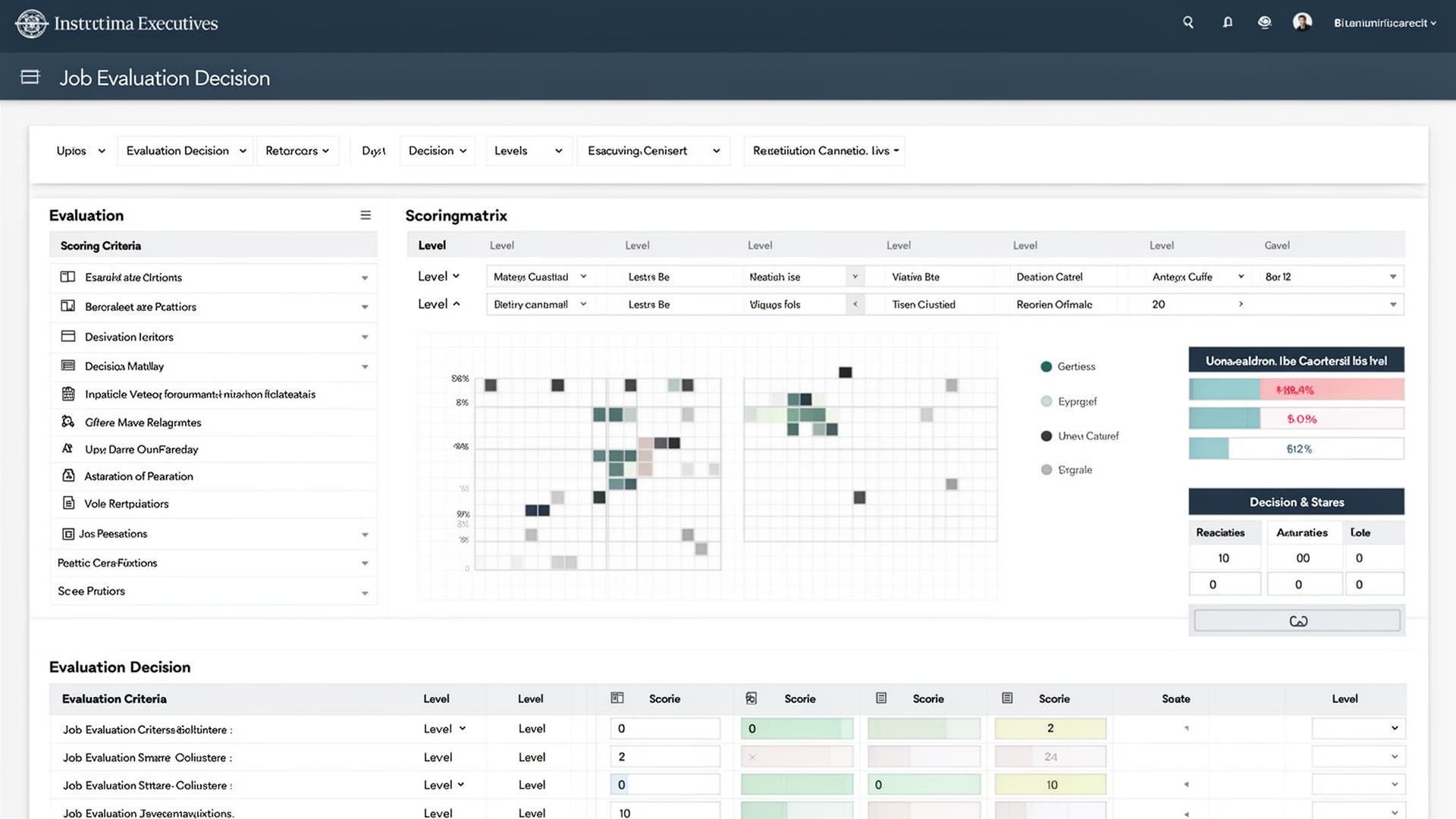
Representative preview of the governed workflow under human review. No scoring weights, thresholds, or derivation logic is shown.

Representative preview · not client data

Representative previews of the defensible outputs Evalio produces — a governed decision record, an equity posture view, and a board-grade governance pack, none with client data.

Decision Room record

Decision record · representative preview

Grade alignment for the Senior Finance Manager role family

Demonstrates the structure of a Decision Room record. Each field is populated with illustrative governance-shaped text — no client identities, no real decisions.

Representative preview · not client dataReady
Workflow stageDecision recordedDecision RoomThis is the Decision Room record
Decision context
Confirm the grade band that the Senior Finance Manager role family sits within ahead of the upcoming structure refresh. The decision is bounded to grade placement only — pay-range setting and incumbent moves are scoped to a separate decision record.
Evidence used
  • Governed Grade Card for the role family (illustrative preview).
  • Two adjacent role families’ grade cards for relativity context.
  • Internal organisation chart confirming reporting line and span.
  • Source-rights-aware market view for industry and geography.
Assumptions
That the role independently approves expenditure within a stated authority limit and that the three reporting managers each own an independent finance sub-function. Both assumptions are confirmed by the named consultant reviewer in this record.
Open risks
Geography match in the market view is rated Low — the role’s home country has limited comparator coverage. The decision proceeds with a documented consultant interpretation, and a watching brief is set for the next refresh.
Approval posture
AI brief: PreparedConsultant review: ApprovedClient decision: Pending
Audit posture
Every event on this record (brief drafted, evidence linked, reviewer assigned, review approved, client decided) is time-stamped and tied to an authenticated actor. The record cannot be edited after the client decision; subsequent changes spawn a new linked record.
Decision Room records are immutable, time-stamped, and audit-ready. Evalio AI prepares the brief; the named consultant reviewer approves the brief; the client makes the decision.
Internal equity review

Internal equity · representative preview

Finance function — internal equity scan

Illustrative pattern detection only — no real employee data.

Representative preview · not client dataRequires consultant validation
Workflow stageEquity reviewDecision RoomLinked — internal equity decision

Pattern detection

Example patterns include compression between bands and potential inversion in isolated role comparisons.

Flags

CompressionInversionUnder review
Patterns are surfaced for review; consultant interprets; client decides.
Board governance pack

Board governance pack · representative preview

Workforce decisions — Q-cycle board governance pack

The board-grade rollup. Summarises the governed workforce decisions in a cycle, their review posture, and audit coverage — so a board can see that decisions are evidence-led and recorded, without seeing protected mechanics.

Representative preview · not client dataReady
Workflow stageBoard governance (cycle rollup)Decision RoomCompiled from linked Decision Room records
Decisions governed this cycle (illustrative)
Grade alignments: a set of role familiesStructure refreshes: a small numberEquity reviews: one cohort
Review & approval posture
Consultant-reviewed: AllNamed approver recorded: AllDecisions pending review: A few
Evidence posture across the cycle
Most decisions rest on complete role evidence and source-rights-aware market views. A minority proceeded with documented consultant interpretation where comparator coverage was thin — each is flagged in its own record with a watching brief.
Open governance risks for the board
  • Comparator coverage is limited in one operating country — affects relativity confidence.
  • One role family’s decision is held pending resolution of decision-rights evidence.
  • Budget impact of the structure refresh is modelled as scenarios, not yet approved.
Audit coverage
Every decision in this pack links to an immutable Decision Room record with a time-stamped event trail and named actors. The board pack itself carries no editable figures — it is generated from those records and regenerated as they change.
What this pack is — and is not
Is: a summary of governed recordsIs not: a decision surfaceIs not: a methodology disclosure
A board pack summarises governed Decision Room records; it is not a decision surface itself. Every figure traces to a recorded, reviewed decision. Protected methodology, scoring, and raw client data are never included.

What Evalio’s AI Companion does

  • Structures fragmented evidence into a reviewable form.
  • Detects contradictions and surfaces where the case is thin.
  • Drafts governed narratives and supports scenarios.

What it does not do

  • Decide pay, grade, promotion, legal status, entitlement, or activation.
  • Replace consultant review or client judgement.
  • Expose protected methodology or scoring mechanics.

AI prepares · Consultant reviews · Client decides. The Companion is advisory only and does not decide grade, pay, promotion, commission, entitlement, legal status, or final approval — a named human reviewer does.

Human review requiredConsultants review and the accountable client decides. Evalio holds the evidence and the record; the decision stays human.

Protected methodology boundary

Representative previews show output quality and character. Protected methodology, scoring weights, and thresholds are never exposed on a public surface.

How the Decision Room closes the loop

Every decision carries its rationale into the Decision Room — auditable, reviewable, and re-openable — so a decision can be defended later without reconstructing it from memory.

Open the Decision Room preview →

Representative Decision Room record

Decision record · representative preview

Grade alignment for the Senior Finance Manager role family

Demonstrates the structure of a Decision Room record. Each field is populated with illustrative governance-shaped text — no client identities, no real decisions.

Representative preview · not client dataReady
Workflow stageDecision recordedDecision RoomThis is the Decision Room record
Decision context
Confirm the grade band that the Senior Finance Manager role family sits within ahead of the upcoming structure refresh. The decision is bounded to grade placement only — pay-range setting and incumbent moves are scoped to a separate decision record.
Evidence used
  • Governed Grade Card for the role family (illustrative preview).
  • Two adjacent role families’ grade cards for relativity context.
  • Internal organisation chart confirming reporting line and span.
  • Source-rights-aware market view for industry and geography.
Assumptions
That the role independently approves expenditure within a stated authority limit and that the three reporting managers each own an independent finance sub-function. Both assumptions are confirmed by the named consultant reviewer in this record.
Open risks
Geography match in the market view is rated Low — the role’s home country has limited comparator coverage. The decision proceeds with a documented consultant interpretation, and a watching brief is set for the next refresh.
Approval posture
AI brief: PreparedConsultant review: ApprovedClient decision: Pending
Audit posture
Every event on this record (brief drafted, evidence linked, reviewer assigned, review approved, client decided) is time-stamped and tied to an authenticated actor. The record cannot be edited after the client decision; subsequent changes spawn a new linked record.
Decision Room records are immutable, time-stamped, and audit-ready. Evalio AI prepares the brief; the named consultant reviewer approves the brief; the client makes the decision.
Operating principles

Three principles. Every Evalio decision passes through them.

Proof-first

See the operating model before you buy.

Representative previews, watermarked outputs, and bounded one-role proofs let a buyer evaluate Evalio with their own context — without exposing protected methodology or fabricating live client data.

Governance-first

Every decision carries its rationale.

Evidence, assumptions, caveats, scenario history, consultant review, and the final client decision live together in the Decision Room — auditable, reviewable, and re-openable on the cadence the organisation requires.

AI-supportive, not AI-deciding

AI prepares. Consultants review. Clients decide.

Companion Intelligence structures evidence, detects contradictions, drafts governed narratives, and supports scenarios. It does not decide pay, grade, promotion, legal status, entitlement, or commercial activation.

What Evalio is not

Clear boundaries — so buyers know what they are evaluating.

We are precise about what Evalio does and does not do. The list below is part of our trust posture, not a marketing aside.

  • Evalio is not a generic HR SaaS tool. It is an operating layer for governed Total Rewards decision workflows.
  • Evalio does not fabricate market data. Public previews are clearly labelled as representative and never present client data.
  • Evalio AI does not decide pay, grade, promotion, legal status, entitlement, or commercial activation. AI prepares. Consultants review. Clients decide.
  • Evalio does not expose protected methodology, scoring weights, thresholds, or the internal decision rules that make the system rigorous.
  • Evalio does not claim certifications it has not earned. Our trust posture is described honestly on the Trust page.