Platform
Governed decision infrastructure for the workforce domain
Job architecture, evaluation, and pay alignment are not separate problems. They are one governed decision system — with structured methodology, controlled interpretation, and reviewable outputs at every stage. Internal logic remains protected by design. Evalio provides the infrastructure where these decisions can be examined, defended, and sustained before they take effect.
Governed decision infrastructure for the workforce domain
A pay decision traces to the evaluation that produced the level, and from there to the architectural definition that framed the role. Nothing is orphaned. Every step can be examined, interpreted, and defended.
Grounded product proof
A decision surface built for HR, Rewards, Finance, and governance review.
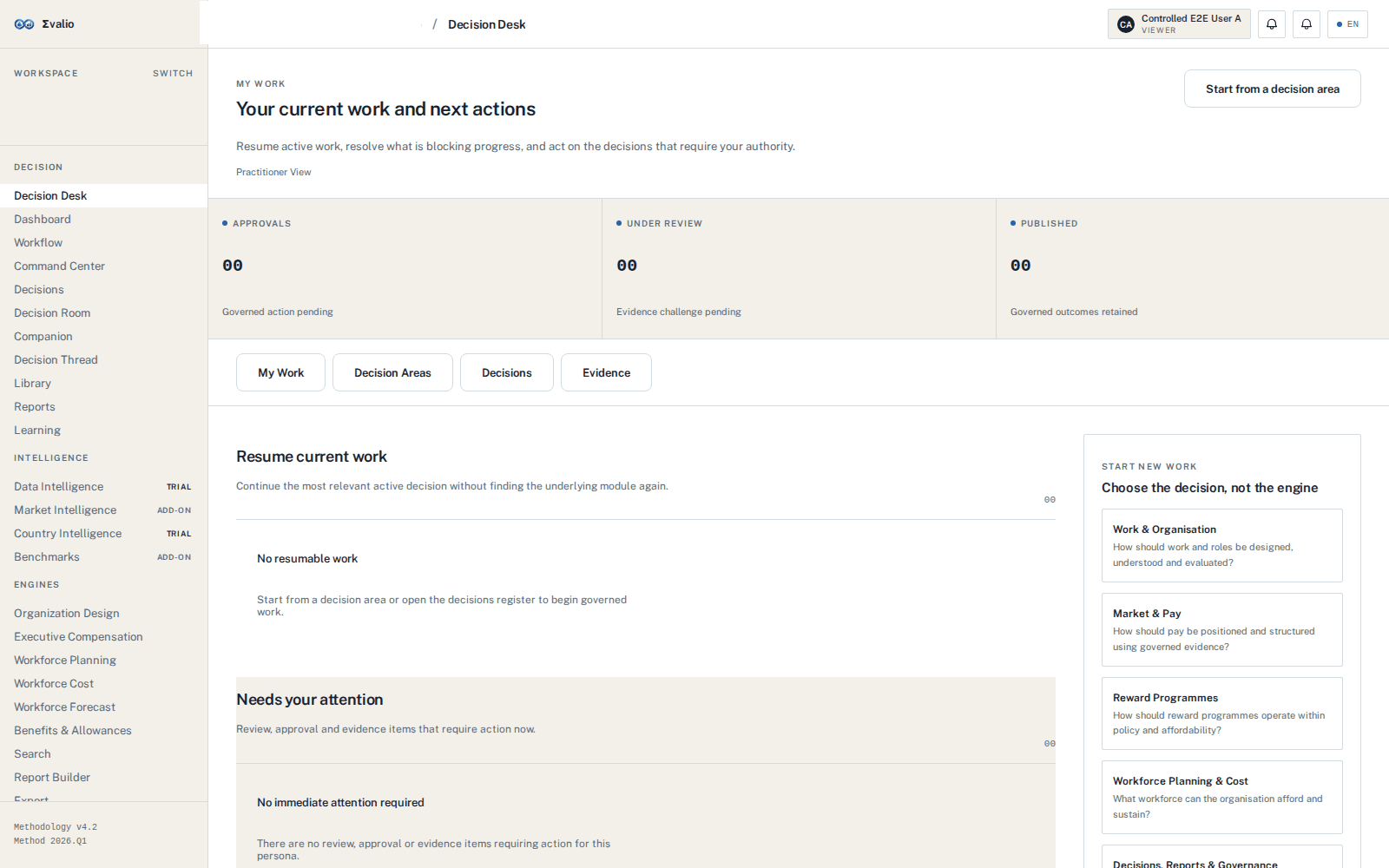
Evalio presents workforce decisions as governed evidence review: leadership context, reward governance, evidence sufficiency, and controlled interpretation before action.
Executive review scene
Senior HR and Finance stakeholders reviewing job-evaluation evidence across GCC, Egypt, and European operating contexts.
Representative interface
Example evaluation result
Governed outcome
G14
Evalio Grade
Example grade only. No raw score, model weights, or protected derivation trail is exposed on the public surface.
Public boundary
- Evalio Grade is shown as the governed outcome; protected scoring mechanics remain confidential.
- Framework equivalence is positioned as interpretive support, not a replacement for governance review.
- Commercial and pricing values remain scoped, contract-led, and honest where final terms are not yet approved.
The cost of fragmented workforce decisions
Pay equity exposure
Compensation disconnected from evaluation creates gaps that cannot be explained or defended under regulatory scrutiny.
Audit fragility
No single decision can be traced from role input to pay output — so the basis for action is invisible to reviewers.
Board confidence erosion
Leadership cannot examine the logic behind workforce decisions they are accountable for.
Inconsistent levelling
Different methods across regions produce outcomes that cannot be compared, challenged, or defended.
Three decision domains, one governed system
Job Architecture
How work is structured
Role families, job levels, career tracks, and reporting relationships — defined with precision and maintained as the connective layer that gives every downstream decision a clearer, more reviewable basis.
Evaluation Domain
How work is assessed
Consistent, structured evaluation criteria applied across roles and regions. Structured evaluation under a public-safe output boundary — so every output can be reviewed, not just accepted. Internal methodology remains protected.
Pay Alignment
How work is compensated
Compensation connected to architecture and evaluation with full traceability. Every pay decision traces to the structure and logic that produced it — giving stakeholders a reviewable basis for action.
One evidence chain from job value to pay action.
Evalio should be read as a governed Total Rewards operating system, not a set of disconnected HR modules. Release-0 proves the evaluation domain; enterprise activation extends the same evidence discipline into compensation, equity, offer, merit, and workforce planning decisions.
Job evaluation
Creates the governed role evidence and grade view that every downstream workforce decision depends on.
Grade and compensation architecture
Connects job value, grade structure, and compensation philosophy without turning confidential methodology into public mechanics.
Salary structures and internal equity
Frames range posture, compression, and cohort equity as governed evidence rather than isolated spreadsheet judgments.
Merit, offer, and workforce planning
Extends the same governed evidence chain into pay actions, hiring decisions, planning scenarios, and approval context.
Broader Total Rewards modules require governed workspace activation and entitlement. Public proof does not fabricate live operating data, approval chains, or market datasets.
How the platform governs workforce decisions.
Structured methodology
Every evaluation follows a defined, governed method under a public-safe output boundary — not ad-hoc judgment. Protected internal logic is not disclosed.
Controlled interpretation
Consultant-guided interpretation accompanies every output — framing confidence, flagging ambiguity, and distinguishing what is well-supported from what needs further review.
Escalation awareness
When evidence is thin, contradictions are present, or confidence is low, the system indicates review or escalation — rather than presenting uncertain results without context.
Workflow discipline
Decisions move through governed states — from intake through evaluation, review, and approval — with output and review context at every stage and clear boundaries on what each output establishes.
Proof-first buyer journey
From public proof to governed enterprise activation.
The journey connects orientation, the Job Evaluation Trial, Decision Room review, trust review, enterprise scoping, and governed Total Rewards activation in one ordered path.
- Step 01Orient
Orient through proof
Start with the teaser and demo library so the category, posture, and proof boundary are clear before trial use.
- Step 02Trial
Start the Job Evaluation Trial
Run one governed job evaluation under a public-safe output boundary, without exposing protected mechanics.
- Step 03Review
Review the Decision Room
Read the result basis, caveats, reference views, and indicated next step as a review surface, not a scoring trace.
- Step 04Trust
Check trust and methodology
Understand what is reviewable, what is protected, how outputs should be used, and why the boundaries exist.
- Step 05Engage
Scope the enterprise corridor
Move from public proof into a governed discussion about workspace activation, roles, countries, and operating scope.
- Step 06Operate
Activate governed modules
Compensation architecture, salary structures, internal equity, merit, offer, and workforce planning activate only through governed entitlement.
End-to-end product lifecycle
The platform is the full Evalio operating lifecycle.
Platform means more than the public site or Release-0. It is the controlled chain from public proof into evaluation, review, Extended handoff, commercial activation, workspace operation, Total Rewards modules, and audit-grade governance.
Orient
01
Watch proof path →Public proof and buyer orientation
The buyer starts with the public estate: platform, solutions, demos, methodology, trust, pricing, and Talk to Evalio. The aim is to understand the decision category and proof boundary before entering the product.
Evaluate
02
Open Release-0 →Release-0 Job Evaluation Trial
One bounded role evaluation captures structured role evidence, organisational context, company-size framing, and public-safe output. The trial proves the posture without becoming the full enterprise workspace.
Review
03
Open Decision Room →Decision Room and artifact interpretation
The result is reviewed as a governed artifact: grade view, evidence posture, review attention, output boundary, and next-step architecture. Protected methodology remains confidential.
Extend
04
Open Extended →Release-0 Extended corridor
Artifact review, readiness, and handoff help the buyer assess whether the bounded trial is strong enough to support guided follow-up or enterprise scoping.
Activate
05
View activation →Commercial activation and entitlement
Stripe remains payment truth, Evalio remains entitlement truth, and workspace activation is governed. Access does not become live merely because a page renders or a payment event exists.
Operate
06
View workspace →Governed workspace and modules
Workspace surfaces carry decisions, records, billing, members, policies, settings, library, benchmarks, country intelligence, and module activation without fabricated operational state.
Reward
07
Open rewards spine →Total Rewards operating modules
The lifecycle extends into compensation workbench, salary structures, internal equity, pay-for-performance, client pay architecture, workforce planning, and governed records.
Govern
08
Review trust →Audit, legal, trust, and decision governance
Outputs, workspace actions, policy posture, legal terms, output-use boundaries, platform-use boundaries, and trust controls keep the product reviewable without exposing protected internal mechanics.