
Less reconstruction
Stop rebuilding the story from email, slides and memory when someone asks why the decision was made.
2 Job Evaluations — Free TrialUse the governed Job Evaluation and Decision Room journey for two role cases.
Decision Room keeps the evidence, assumptions, alternatives, challenge and final human decision together. Months later, the organisation can still understand what it chose, why it chose it and what evidence was available at the time.
The Evalio aha
The decision is not only the answer. It is the evidence, alternatives, challenge and reasoning that made the answer credible.
Executive briefing
A concise briefing on the decision context and connected consequences leaders should consider before committing.
Synthetic narration — this briefing uses an AI-generated voice. The script and decision content are authored and governed by Evalio.
Many organisations try to make workforce decisions defensible after they have already been made.
That is too late. By then, the context has moved, the assumptions are harder to recover, and the consequence chain may already be visible to finance, employees, or the Board.
Evalio changes the sequence. Evidence, assumptions, impact, review posture, and accountable sign-off are assembled while the decision is still forming.
Inside the Decision Room, leaders can see what is known, what is limited, what requires review, and what must remain accountable to human judgment.
That creates a decision record leaders can explain, revisit, and govern without exposing proprietary methods.
Analysis is not the same as confidence.
Governance is not about slowing decisions. Governance is about preserving confidence in decisions over time.
Where decisions become defensible. Request Proof Access.
Full narration transcript for this briefing.
The buyer should not need to understand a workflow engine. They should be able to see how a consequential question becomes an accountable decision.
Show how a governed decision moves from framing to a sealed, auditable record.
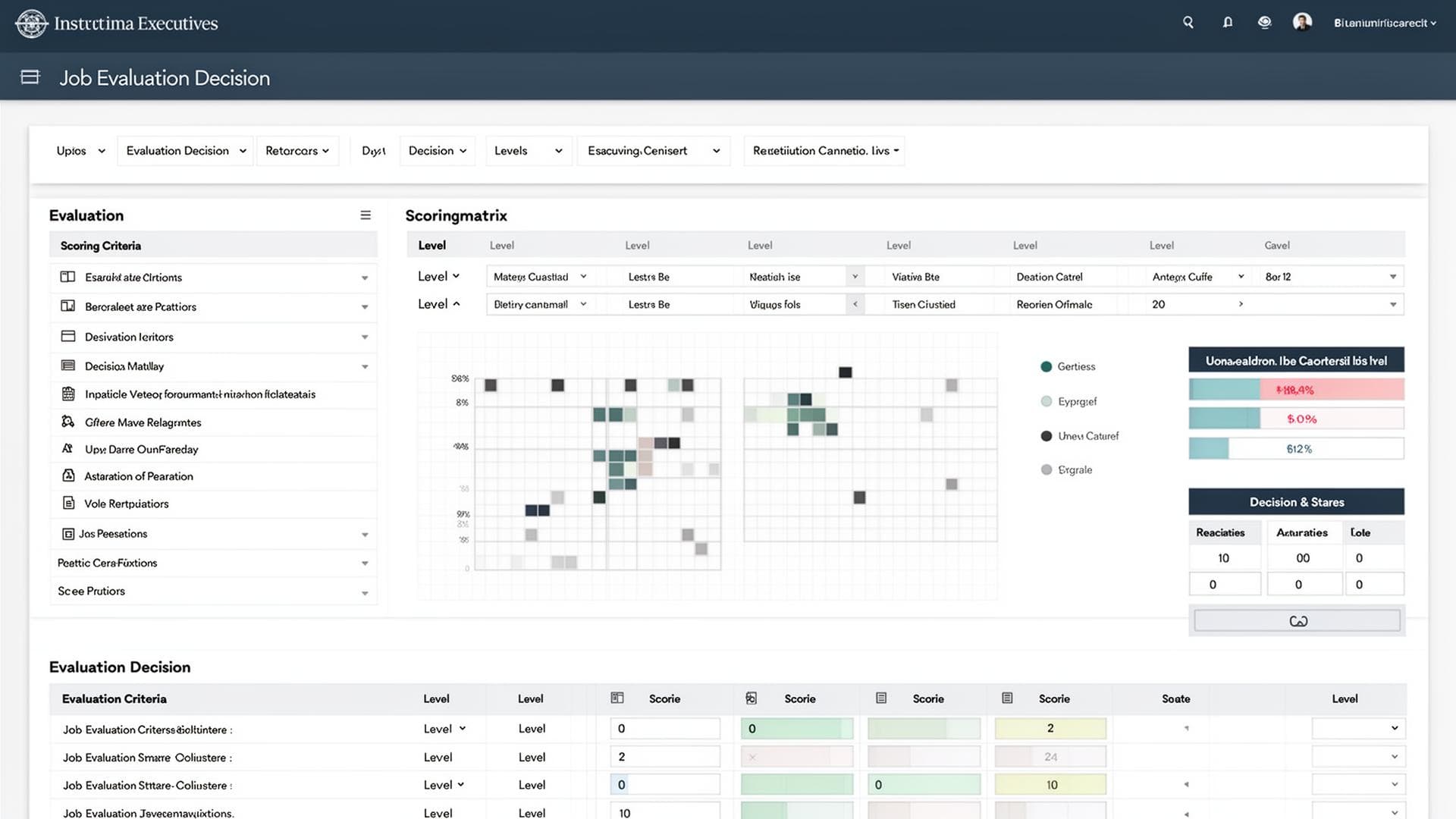
In the Decision Room a decision is framed, its evidence assembled, its options reviewed, then approved by an accountable owner and sealed as an auditable record with a governed artifact envelope. The Decision Room is the system of governed record — every downstream artifact traces back to its sealed decision.
Name the question, the owner and what is at stake before the discussion fragments into opinions.
Bring the relevant evidence, assumptions and missing information into the same case.
Make alternatives, trade-offs and unanswered questions visible before the preferred option becomes inevitable.
Keep professional review and disagreement attached to the decision rather than disappearing after the meeting.
Preserve the final rationale and accountable human approval so the organisation can understand the decision later.
Decision Room is useful when a choice may need to be explained later — to another executive, a new manager, Finance, HR, a committee or the team implementing it.
Stop rebuilding the story from email, slides and memory when someone asks why the decision was made.
Make disagreement useful by keeping the question and the response attached to the case.
See who recommended, who reviewed and who ultimately authorised the outcome.
When circumstances change, reopen the reasoning rather than starting from an unexplained historical answer.
Companion Intelligence can summarise evidence, surface gaps and help frame alternatives. It cannot approve pay, grades, promotions, restructuring or workforce action. The named human authority owns the decision.
Better technology should make human judgement more visible — not quietly replace it.
See the decision, not a feature list
Inspect the Decision Room proof first, then bring your organisation's decision when you want to see how the same approach could fit your context.