
Evaluate the job
Evaluate the job and preserve the evidence behind the conclusion.
2 Job Evaluations — Free TrialUse the governed Job Evaluation and Decision Room journey for two role cases.
Evalio · Workforce Decisions
Evalio connects work, value, market, reward, workforce cost and planning so leaders can see the consequences before they commit.
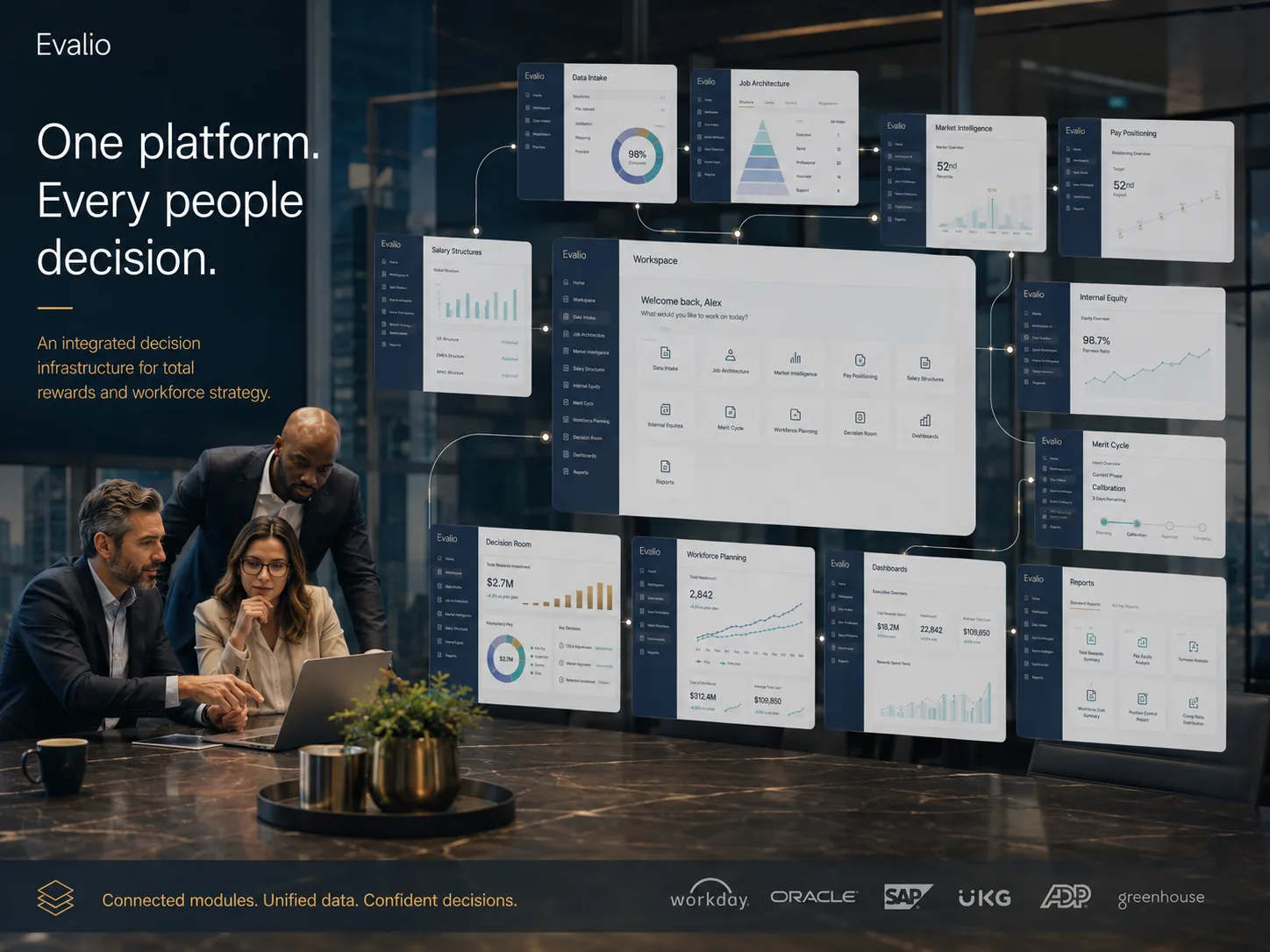
A grading decision can change market position. A market move can change equity. A structure change can change workforce cost. Start with the decision on your desk — not with a software menu.
Do the same roles sit at the same level across the organisation — and can we show why?
Start here →Market credibilityWhen we cite the market to justify a pay decision, do we know where that number came from and what it does not cover?
Start here →EconomicsDo our reward decisions and our workforce budget run on the same numbers — or two versions of the truth?
Start here →Cost controlBefore we commit to a headcount or cost decision, can we compare the options with their assumptions visible?
Start here →GovernanceDo our material workforce decisions pass through evidence, review, and challenge before they are final?
Start here →Not sure where to begin? Start with the decision leadership needs to make now. Evalio can reveal the connected reward, workforce-cost and governance consequences without asking you to learn the platform first.
Find What You Need →Executive briefing
A concise briefing on the decision context and connected consequences leaders should consider before committing.
Synthetic narration — this briefing uses an AI-generated voice. The script and decision content are authored and governed by Evalio.
Every workforce decision ends with an answer. Approve the role. Set the pay.
Change the structure. Commit the budget.
But the answer is only the end of the story. What evidence shaped the decision?
Which assumptions were challenged? What alternatives were considered?
What risks were accepted?
Too often, those answers are scattered
across spreadsheets, meetings, market data and individual
judgement. The decision moves forward. Costs change.
People feel the impact. The organisation lives with the consequences. Then, months
later, someone asks: Why did we decide this? Evalio brings evidence, expertise,
challenge and governance into one decision process — preserving not
only what was decided, but why. So workforce decisions
can be reviewed, explained and defended. Evalio. Defensible workforce decisions.
Full narration transcript for this briefing.
Established approaches brought rigour to evaluation, market benchmarking, reward architecture and workforce planning. Today the harder problem is seeing how those decisions interact before the organisation commits.
Evaluate the job
Evaluate the job and preserve the evidence behind the conclusion.
Read the benchmark
Interpret market evidence against role value, equity, talent pressure and affordability.
Design the range
See what the range changes in compression, employee position and future fixed cost.
Build the headcount plan
Plan the work, capability, capacity and economics required to execute the strategy.
Make the recommendation
Keep the alternatives, challenge, approval and rationale attached to the decision.
Evalio keeps professional questions distinct, then connects their consequences. Job value is not market price. Market price is not pay. Headcount is not capability. A model output is not an approval.
What work exists, how is it changing and what is it genuinely worth?
Role Evidence · Job Architecture · Job Evaluation · Leveling & Grading
02What does external evidence mean for this organisation — not merely what percentile is available?
Market Intelligence · Pay Positioning
03How should pay architecture balance competitiveness, equity, progression and affordability?
Salary Structures · Internal Equity · Merit · Benefits
04What workforce can the strategy afford, and what capability is lost or gained under each option?
Workforce Cost · Workforce Planning & Budgeting · Scenarios
05What evidence, trade-offs and uncertainty should remain visible when accountable leaders decide?
Decision Room · Executive Intelligence · Reports & Exports
A confident methodology does not force certainty. It shows what moved, what did not, what remains unproven and which downstream decisions should now be reconsidered.
What changed
The role now carries broader geographic scope and greater stakeholder complexity.
What did not
No stronger evidence shows additional budget authority or materially wider decision rights.
Evalio view
G14 recommendation · Moderate confidence. Formal decision authority remains an open evidence question.
Now the market reference, employee position, internal-equity pattern and workforce-cost consequence can be examined without pretending the original grading question existed in isolation.
Show that AI structures evidence and options while a human remains accountable for the recorded decision.
Evidence flows into AI structuring, which organizes inputs and surfaces options but never decides. A human expert reviews and remains accountable, and the outcome is a governed decision that is recorded and auditable. Companion Intelligence is bounded, human-augmented support — not an autonomous engine.
The professional question stays the same. The stakes change depending on who is accountable for the outcome.
CHRO
See the consequence chain before the recommendation becomes a commitment.
See this perspective →CFO
See workforce economics, alternatives and recurring exposure rather than a budget request in isolation.
See this perspective →Total Rewards
Inspect the evidence, professional distinctions, uncertainty and review history behind the answer.
See this perspective →CEO / Board
Connect organisation, capability, cost, scenarios and accountable action around the strategic choice.
See this perspective →Use representative product proof, professional methodology and decision-led insight to decide whether Evalio’s approach is strong enough for your organisation.
Inspect role evidence, evaluation, confidence, review and downstream consequences.
Inspect →See the professional foundations, four domains, twelve subcriteria and evidence discipline.
Inspect →Explore decision-led perspectives on work, reward, workforce economics and what is changing now.
Inspect →Representative scenarios are labelled. Protected methodology remains protected. AI may analyse, explain, challenge and simulate; accountable people retain decision authority.
Use your own question to test whether the evidence, trade-offs and consequences become clearer — before you make a larger commitment.