
1. Structure the evidence
Role descriptions, workforce context, and decision questions are organized into reviewable records. Missing or contradictory information remains visible.
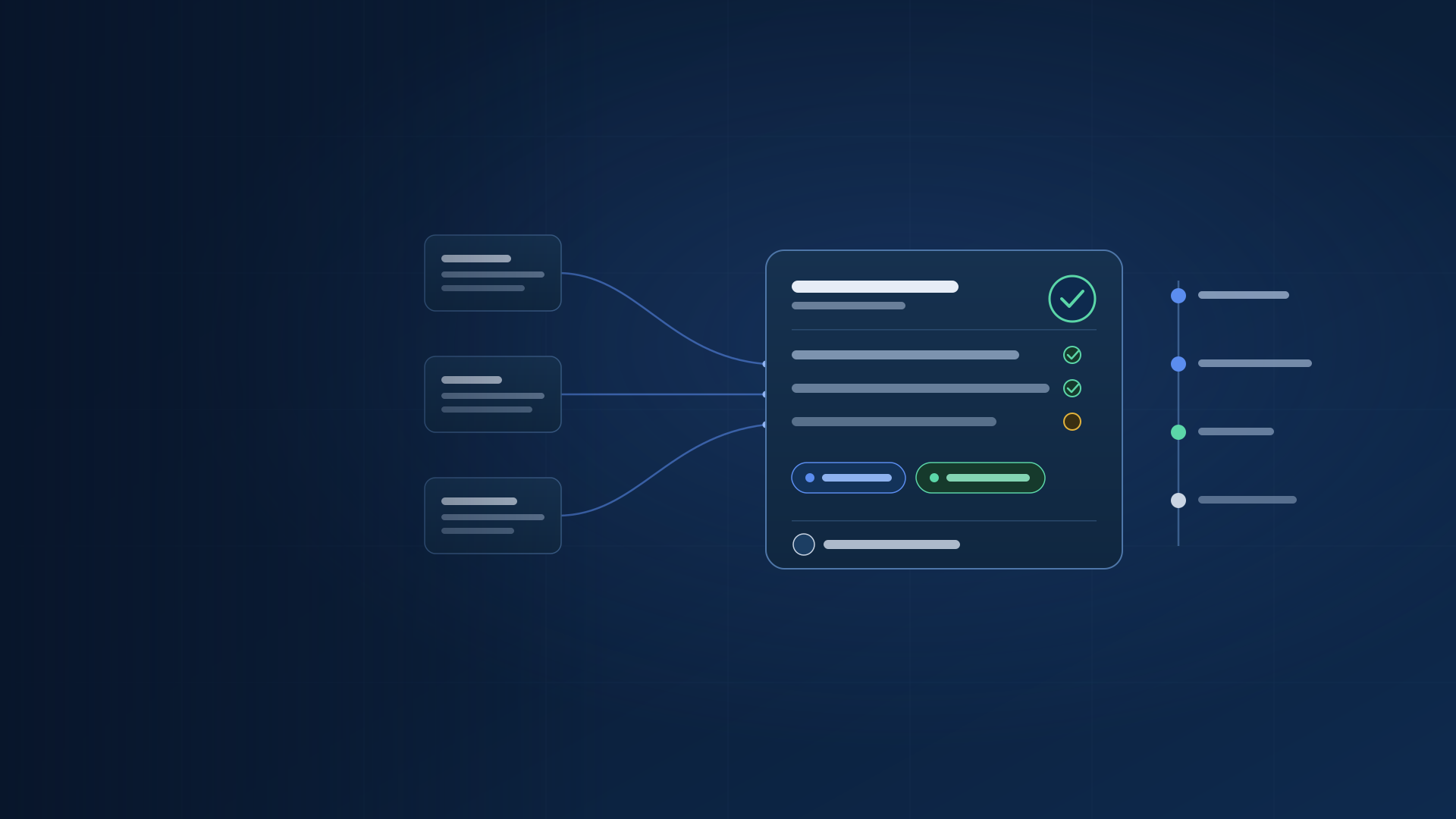
Evalio organizes role, reward, structure, and workforce questions into a guided operating flow: evidence intake, structured review, controlled outputs, and decision records.
Role descriptions, workforce context, and decision questions are organized into reviewable records. Missing or contradictory information remains visible.
Evalio shows decision context, confidence posture, output boundaries, and next steps without exposing protected internal mechanics.
Outputs move into review, approval, reporting, and Decision Room records so decisions remain traceable and explainable.
From evidence to a recorded decision
For: Anyone who needs to understand, concretely, how a workforce question becomes a defensible, recorded decision in Evalio.
Module workflow — input → Evalio workflow → representative artifact → human governance → Decision Room record → next action
Structure the evidence
Role descriptions, workforce context, and the decision question are organised into reviewable records; gaps stay visible.
Review the trade-offs
Evalio shows decision context, confidence posture, and output boundaries without exposing protected mechanics.
Produce a bounded output
A representative artifact — an indicative grade view or decision record — is produced for review.
Reviewer approves
A named reviewer confirms the evidence basis before the output becomes a decision input.
Preserve the record
Outputs move into review, approval, and a Decision Room record so decisions stay traceable.
Run a bounded proof
Try one bounded role evaluation and review the result in the Decision Room.
Representative preview of the governed workflow under human review. No scoring weights, thresholds, or derivation logic is shown.
Representative previews of the three artifacts the flow produces — structured evidence in, an indicative grade view, and the governed decision record that results.
Role evidence record · representative preview
The entry point to every Evalio decision. Raw role input is structured into reviewable evidence vectors before any grade, level, or pay view is produced. No scoring is applied at this stage.
Grade card · representative preview
Shows the shape of a governed Grade Card. Role evidence is summarised; the indicative grade position is bounded to a token; consultant review is required before any decision.
Decision record · representative preview
Demonstrates the structure of a Decision Room record. Each field is populated with illustrative governance-shaped text — no client identities, no real decisions.
What Evalio’s AI Companion does
What it does not do
AI prepares · Consultant reviews · Client decides. The Companion is advisory only and does not decide grade, pay, promotion, commission, entitlement, legal status, or final approval — a named human reviewer does.
Protected methodology boundary
The flow shows what enters, what is produced, and who approves. The internal logic that derives the result is never shown on a public surface.
How the Decision Room closes the loop
The output, its evidence basis, and the review become a governed record in the Decision Room — reviewable later without rerunning the evaluation.
Open the Decision Room preview →Representative Decision Room record
Decision record · representative preview
Demonstrates the structure of a Decision Room record. Each field is populated with illustrative governance-shaped text — no client identities, no real decisions.
Platform
Evalio is the governed operating layer where workforce-decision evidence becomes decisions, decisions become records, and records become institutional memory. Job architecture, evaluation, market intelligence, salary structure, equity, merit, and workforce planning run on one governed chain — structured methodology, human approval, and a defensible record at every stage. Protected internal logic stays inside the boundary by design.
Compensation disconnected from evaluation creates gaps that cannot be explained or defended under regulatory scrutiny.
No single decision can be traced from role input to pay output — so the basis for action is invisible to reviewers.
Leadership cannot examine the logic behind workforce decisions they are accountable for.
Different methods across regions produce outcomes that cannot be compared, challenged, or defended.
Evalio is not a set of disconnected HR tools. It is a governed operating layer: each layer does one job, hands a bounded output to the next, and leaves a record behind. The methodology that makes each layer rigorous stays inside the protected boundary.
Structures messy role, organisational, and market inputs into reviewable evidence — gaps stay visible rather than silently filled.
Runs the protected evaluation method to produce an indicative grade view under a public-safe output boundary.
Models structure, pay, equity, merit, and workforce options side by side — without committing any of them.
Holds the evidence, assumptions, scenarios, reviewer, and decision as one governed record.
Summarises, challenges, compares, and highlights risk to support the reviewer — it never decides.
Enforces human approval, role-based access, tenant isolation, and methodology protection across every action.
Generates board-ready records, summaries, and packs from the decision — representative previews stay labelled.
Preserves evidence lineage, reviewer, and timestamps so any decision can be re-opened and defended later.
Every material workforce decision moves along one governed chain. The system structures and evaluates; Companion Intelligence supports; an accountable human approves; the Decision Room records. Nothing advances past review without a named reviewer.
Messy inputs
Role descriptions, org context, market signals, and the question arrive unstructured.
Governed system step.Structured evidence
Inputs become reviewable evidence with gaps and assumptions made visible.
Governed system step.Governed evaluation
The protected method produces an indicative grade view under a public-safe boundary.
Governed system step.Scenario modeling
Structure, pay, equity, and budget options are compared without commitment.
Where Companion Intelligence supports.Human review
A named reviewer confirms the evidence basis and tests the assumptions.
Where an accountable human approves.Approval
An accountable leader approves — the decision is human, not automated.
Where an accountable human approves.Decision record
The decision, reviewer, evidence, and timestamp are written to the Decision Room.
Governed system step.Artifact generation
Board-ready summaries and packs are produced from the recorded decision.
Governed system step.Audit trail
Lineage from input to output stays intact and re-openable for scrutiny.
Governed system step.Institutional memory
The record becomes durable context the organisation can defend and reuse.
Governed system step.Evalio is workforce decision infrastructure. Decision records and human review are primary; governed AI supports evidence review, challenge, explanation, and decision-trail preparation within explicit boundaries.
The durable unit is the reviewable record: facts, evidence, assumptions, risks, alternatives, uncertainty, recommendation, and human review state.
AI-supported output remains advisory. Human review is required before a workforce decision is approved or acted on.
Companion Intelligence helps surface assumptions, identify risks, compare alternatives, and explain evidence boundaries.
Evalio does not make autonomous workforce decisions, approve pay, decide promotions, or trigger restructuring actions.
Each surface carries real workflow meaning — evidence in, a governed run, a bounded output, human review, and a recorded decision. Broader surfaces require governed workspace activation and entitlement.
The governed record holding evidence, assumptions, scenarios, approvals, and the decision itself.
Role families, levels, and career tracks maintained as the connective layer beneath every decision.
Source-bound market posture treated as governed evidence — never fabricated survey data.
Range design, midpoints, and compression modelled against evaluation and market posture.
Cohort and pay-gap exposure framed as reviewable evidence ahead of any pay action.
Merit and pay-for-performance scenarios built on the same governed evidence chain.
Headcount, budget, and structure scenarios modelled before they harden into commitments.
Representative, labelled previews of the artifacts each surface produces.
Where approval, access, isolation, and methodology-protection posture are made explicit.
The bounded assistant that summarises, challenges, and highlights risk for the reviewer.
Decision Room is not a video call or a shared inbox. It is the governed record where the evidence, assumptions, scenarios, reviewer, approval, and decision are held together as one defensible artifact.
Because the record is produced as part of the work, the audit trail is never reconstructed under pressure. A decision made today can be re-opened, examined, and defended months later — with its evidence basis intact.
The core
Companion Intelligence is a bounded assistant. It helps reviewers move faster and see more — but it has no authority over outcomes. The boundary is stated on the page, not buried in a policy.
What Evalio’s AI Companion does
What it does not do
AI prepares · Consultant reviews · Client decides. The Companion is advisory only and does not decide grade, pay, promotion, commission, entitlement, legal status, or final approval — a named human reviewer does.
Each surface produces a bounded, board-ready artifact. The previews below are representative — labelled, watermarked, and free of client data, scoring weights, or derivation logic.
Representative previews — not client data. No scoring weights, thresholds, or derivation logic is shown. Live artifacts are produced inside a governed workspace.
Decision record · representative preview
Demonstrates the structure of a Decision Room record. Each field is populated with illustrative governance-shaped text — no client identities, no real decisions.
Job evaluation summary · representative preview
The reviewable evaluation outcome. It consolidates the role evidence into a placement conclusion and its rationale, without exposing the protected scoring engine, factor weights, or derivation logic.
Salary structure · representative preview
Demonstrates how Evalio frames a governed grade-and-band structure. No currency values, no absolute midpoints, no percentiles, no comparator identities. Real structures derive from your own bound data under consultant review.
Structure geometry
Geometry is rendered qualitatively because absolute pay values are never disclosed in preview.
Structure narrative
Governed outputs describe how grades relate to one another — band width, the step between successive midpoints, and how adjacent bands overlap — so reviewers can reason about progression and consistency. Evalio frames this as a structure shape, not a published pay scale, until your own data and source-rights are bound to the workspace.
Included in governed output
Not shown in any preview
Internal equity · representative preview
Illustrative pattern detection only — no real employee data.
Pattern detection
Example patterns include compression between bands and potential inversion in isolated role comparisons.
Flags
Workforce planning · representative preview
Demonstrates how Evalio frames a governed workforce-planning summary. No headcount numbers, no cost values, no named individuals. Real summaries run against your own bound org data under consultant review.
Planning posture
Posture is rendered qualitatively because headcount and cost figures are never disclosed in preview.
Planning narrative
Governed summaries describe which roles are business-critical, where capability or succession depth is thin, and whether span-of-control and layering sit inside agreed guardrails — so reviewers can prioritise action. Evalio frames the structure and the flags; it does not publish headcount, cost, or named-person data until your own org data is bound to the workspace.
Included in governed output
Not shown in any preview
Board governance pack · representative preview
The board-grade rollup. Summarises the governed workforce decisions in a cycle, their review posture, and audit coverage — so a board can see that decisions are evidence-led and recorded, without seeing protected mechanics.
Executive dashboard view · representative preview
The executive read-out of the decision portfolio: which states are tracked — in evidence, in review, sealed, or pending validation. Every item traces to a Decision Room record — none exposes a raw score, weight, or threshold.
Each commitment is a property of how the platform is built — visible on the surface and verifiable by a buyer, auditor, or board.
No material decision advances without a named, accountable reviewer.
Evidence, reviewer, and timestamp are recorded as part of the work.
What each person can see and do follows their governed role.
Each organisation's evidence and records stay isolated by design.
Every output traces back to the inputs and method that produced it.
Pay traces to evaluation; evaluation traces to architecture. Nothing is orphaned.
Scoring weights, thresholds, and derivation logic stay inside the boundary.
Representative previews are always labelled and never shown as live data.
Evalio is activated through guided executive engagement, not self-serve sign-up. Each step is governed, reversible, and scoped to your decision population.
A scoped conversation on the workforce decisions you need to govern and defend.
Examine representative artifacts and the bounded evaluation corridor before any commitment.
A governed workspace is scoped to your population, roles, and access posture.
Run a real decision end to end — evidence, review, approval, and recorded artifact.
Extend the same governed chain across evaluation, pay, equity, merit, and planning.
Activation is contract-led and entitlement-scoped. Public surfaces never expose live operating data or approval chains.
Proof-first buyer journey
The journey connects orientation, the Job Evaluation Trial, Decision Room review, trust review, enterprise scoping, and governed Total Rewards activation in one ordered path.
Orient through proof
Start with the teaser and demo library so the category, posture, and proof boundary are clear before trial use.
Start the Job Evaluation Trial
Run one governed job evaluation under a public-safe output boundary, without exposing protected mechanics.
Review the Decision Room
Read the result basis, caveats, reference views, and indicated next step as a review surface, not a scoring trace.
Check trust and methodology
Understand what is reviewable, what is protected, how outputs should be used, and why the boundaries exist.
Scope the enterprise corridor
Move from public proof into a governed discussion about workspace activation, roles, countries, and operating scope.
Activate governed modules
Compensation architecture, salary structures, internal equity, merit, offer, and workforce planning activate only through governed entitlement.
End-to-end product lifecycle
The public journey leads into governed proof, structured access, workspace operation, Decision Room review, dashboards, reports, and audit-grade governance.
Orient
01
The buyer starts with the public estate: platform, solutions, demos, methodology, trust, pricing, and Talk to Evalio. The aim is to understand the decision category and proof boundary before entering the product.
Evaluate
02
One bounded role evaluation captures structured role evidence, organisational context, company-size framing, and public-safe output. The trial proves the posture without becoming the full enterprise workspace.
Review
03
The result is reviewed as a governed artifact: grade view, evidence posture, review attention, output boundary, and next-step architecture. Protected methodology remains confidential.
Scope
04
Artifact review, readiness, and handoff help the buyer assess whether the bounded trial is strong enough to support guided follow-up or enterprise scoping.
Activate
05
Stripe remains payment truth, Evalio remains entitlement truth, and workspace activation is governed. Access does not become live merely because a page renders or a payment event exists.
Operate
06
Workspace surfaces carry decisions, records, billing, members, policies, settings, library, benchmarks, country intelligence, and module activation without fabricated operational state.
Reward
07
The lifecycle extends into compensation workbench, salary structures, internal equity, pay-for-performance, client pay architecture, workforce planning, and governed records.
Govern
08
Outputs, workspace actions, policy posture, legal terms, output-use boundaries, platform-use boundaries, and trust controls keep the product reviewable without exposing protected internal mechanics.